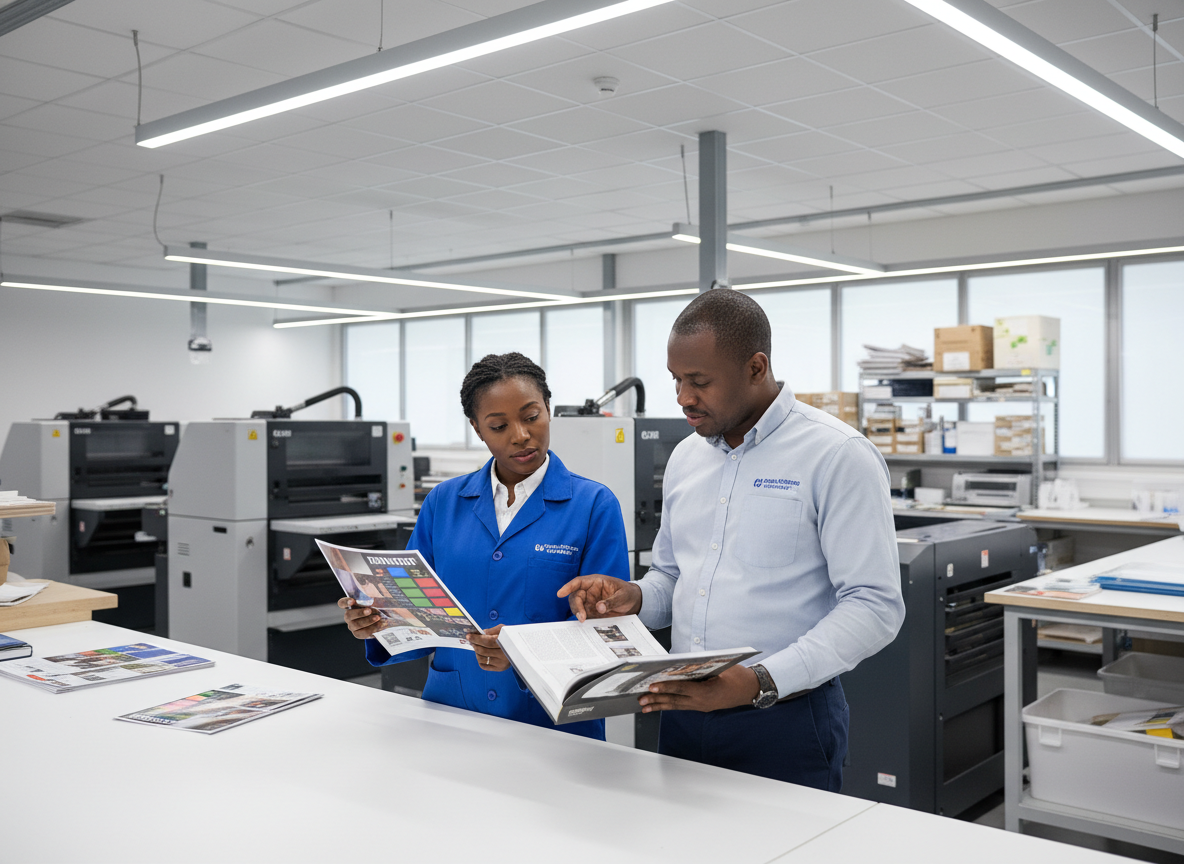
One of the most common questions we hear from businesses in Accra is: "Should I use digital or offset printing?" The answer depends on your specific project requirements — quantity, timeline, budget, and intended use. This guide breaks down both methods to help you make the right choice.
Digital Printing: The Quick Overview
Digital printing transfers your design directly from a digital file to the printing surface, without the need for plates. It's fast, flexible, and cost-effective for shorter runs.
Best For:
- Quantities under 1,000
- Urgent jobs (same-day to 5 days)
- Personalized or variable data printing
- Test runs before committing to large volumes
- Short-run marketing materials
Typical Products:
Flyers, business cards, posters, brochures, labels, certificates, banners
Offset Printing: The Quick Overview
Offset printing uses metal plates to transfer ink to a rubber blanket, then onto the paper. The plate setup takes time and cost, but once running, offset delivers exceptional quality at high speed and low per-unit cost.
Best For:
- Quantities over 1,000
- Projects where colour accuracy is critical (Pantone matching)
- Books, magazines, and multi-page publications
- Regular publications that need consistency across issues
- Premium materials requiring special finishing
Typical Products:
Books, annual reports, magazines, brochures, folders, corporate stationery
Head-to-Head Comparison
Cost
Digital wins for small quantities. No plate setup means lower upfront costs. But as quantity increases, offset's per-unit cost drops significantly, making it more economical for runs above 1,000.
Quality
Both deliver excellent quality. Modern digital printing rivals offset for most applications. However, offset still has the edge for Pantone colour matching, fine detail on large runs, and consistency across tens of thousands of copies.
Speed
Digital wins for turnaround. Same-day to 5 days for digital, versus 5–10 working days for offset. If time is critical, digital is the clear choice.
Flexibility
Digital wins for customization. Variable data printing, personalization, and easy design changes between prints are only possible with digital. Offset requires new plates for any design change.
Finishing Options
Both support premium finishing. Lamination, embossing, foiling, and die-cutting work with both methods. However, offset's heavier paper stocks and larger sheet sizes offer more finishing possibilities.
The Decision Framework
Choose Digital When:
- You need fewer than 1,000 copies
- You need it within 1–5 days
- Each piece needs to be different
- You're testing a design before a larger run
- Budget is tight but quality matters
Choose Offset When:
- You need more than 1,000 copies
- You can wait 5–10 working days
- Colour accuracy is critical (Pantone matching)
- You're printing books, magazines, or multi-page documents
- You need premium finishing (embossing, foiling)
Why Not Both?
Many of our clients use both methods strategically. For example: digital printing for a test campaign of 500 flyers, then offset for the full 10,000 run once the design is proven. Or digital for personalized event invitations, and offset for the event programme booklets.
At SpeedPrints Ghana Limited, we offer both digital and offset under one roof, so we can recommend the best approach for every project. Get an instant quote to compare pricing, or talk to our team for expert advice.