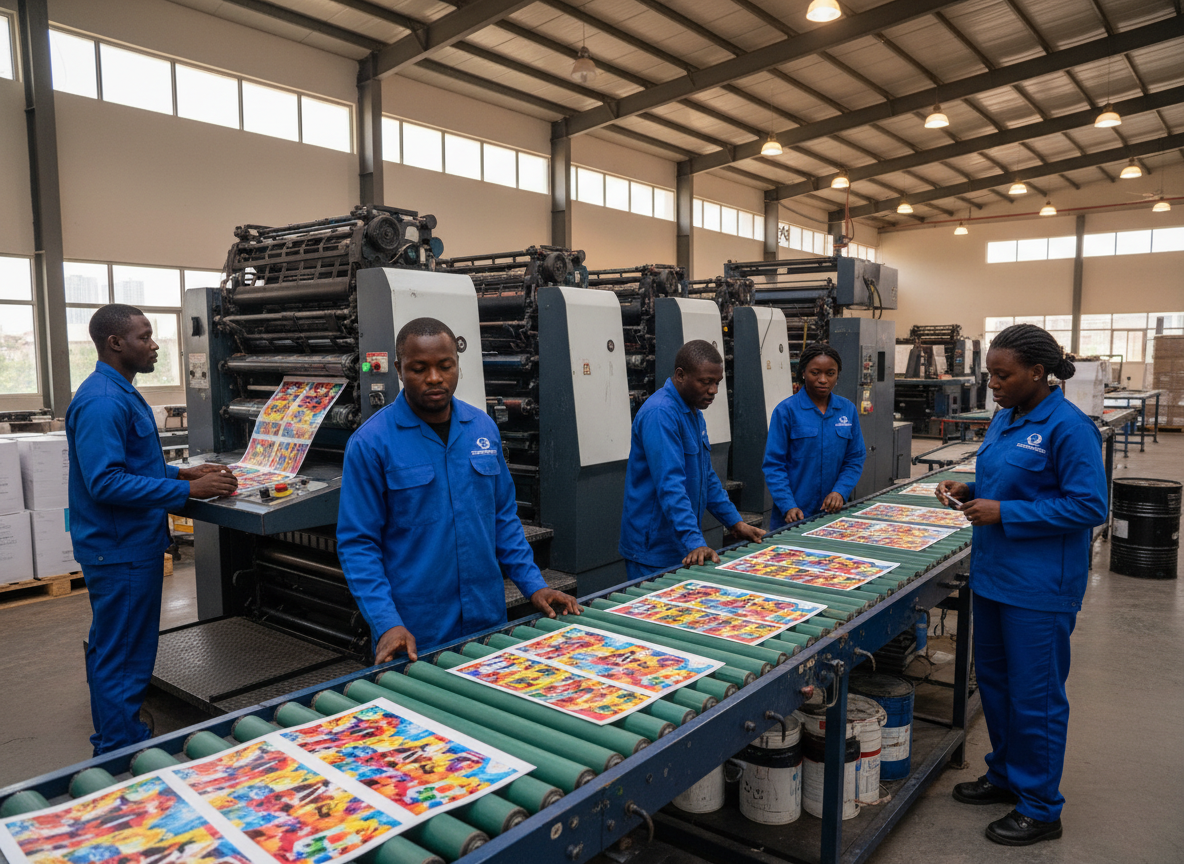
If you have been in printing long enough, you have seen it happen. A quote goes out fast to win the job. The client accepts. Production starts. Then the numbers start slipping. A few extra plates. A paper change. A finishing surprise. A rush delivery. By the time the job is done, you have worked hard and still made little profit.
This is the quiet killer in many African print businesses. It is not lack of sales. It is underpricing, inconsistent estimating, and scope creep that nobody catches early.
This article breaks down why print shops underprice, what a solid estimating process looks like, and how print estimating software and printing quotation software help protect margins without slowing your sales team down.
Why print shops underprice in the real world
Underpricing rarely comes from one big mistake. It comes from many small costs that are easy to ignore when you are trying to respond quickly.
Here are the most common hidden costs that eat margins.
1. Waste and spoilage
Every print job has waste. There is make-ready, test sheets, colour balancing, trimming losses, and sometimes reprints. If your quote assumes perfect yield, you are already losing money.
Waste is also not only paper. It can be ink, plates, laminating film, time, and even delivery costs when a job has to be redone.
2. Make-ready and setup time
Setup is real work. Plate mounting, machine calibration, registration, cutting setup, folding setup, and binding setup all take time before the first sellable piece comes out.
If you only price the run time and ignore setup, short runs become unprofitable very quickly.
3. Labour and supervision
Many quotes include a rough labour number, but labour is usually the most inconsistent part of estimating. A job that looks simple on paper can require extra hands during finishing, packing, and dispatch.
Also, supervision time matters. Someone is checking quality, chasing approvals, and coordinating handoffs.
4. Finishing and outsourced steps
Finishing is where surprises happen. Lamination, foiling, embossing, die cutting, perfect binding, stitching, and numbering can add cost fast.
If you outsource any step, you also carry risk. Supplier delays, minimum charges, and transport costs can wipe out margin if not built into the quote.
5. Overhead that never gets recovered
Power, generator fuel, rent, machine maintenance, and admin costs do not disappear because you priced a job low. If overhead is not built into your estimating model, you end up busy but broke.
Standardizing estimating so pricing is consistent
The goal is not to make quoting complicated. The goal is to make it repeatable.
A strong estimating system usually has four foundations.
1. A materials library
You need a clean list of your common substrates and consumables.
- Paper and board types and sizes
- Ink and toner assumptions
- Plates, chemicals, laminating film
- Packaging materials
When your materials are standardized, your quotes stop depending on who is on shift.
2. Machine rates that reflect reality
Machine rates should include more than the operator.
A practical machine rate often includes:
- Depreciation and maintenance
- Power and fuel assumptions
- Typical setup time
- Typical waste assumptions
- Operator and helper labour
If you do not know your exact rate yet, start with a baseline and improve it monthly using actual job results.
3. Labour costs and time standards
Set time standards for common steps.
- Prepress and imposition
- Plate making
- Printing setup and run
- Cutting, folding, stitching, binding
- Packing and dispatch
Even simple time standards reduce guesswork.
4. Overhead allocation
Overhead can be applied as:
- A percentage markup on direct costs
- A fixed overhead per job
- A blended hourly rate
The method matters less than consistency. The key is that overhead is included every time.
Approval thresholds and revision history to stop scope creep
Scope creep is one of the biggest reasons profitable quotes become unprofitable jobs.
Two simple controls help.
Approval thresholds
Set rules that force review when:
- Discount exceeds a certain percentage
- Margin drops below a minimum
- Rush delivery is requested
- A job includes complex finishing
This protects the business without slowing down every quote.
Revision history
Clients change specs. That is normal. What hurts is when changes happen without a clear record.
Revision history helps you track:
- What changed and when
- Who approved it
- How the price changed
It also makes it easier to explain pricing to the client without arguments.
Volume-based pricing tiers and rush surcharges
Print pricing is not one price. It is a curve.
Volume tiers
A good quoting model makes it easy to offer options.
- 500 copies
- 1,000 copies
- 2,000 copies
- 5,000 copies
This helps clients choose based on budget, and it helps you protect margin because you are not guessing.
Rush surcharges
Rush jobs are not only about speed. They disrupt your schedule and increase risk.
A rush surcharge can cover:
- Overtime
- Priority setup
- Higher waste risk
- Faster delivery costs
The key is to make rush pricing a standard rule, not a negotiation every time.
How PressOps helps you quote faster without losing margin
PressOps was built for print operations, so estimating is not an afterthought.
Agyin AI quote drafting
Agyin helps draft quotes based on job details, your pricing rules, and your past patterns. Your team still reviews and approves, but the first version is faster and more consistent.
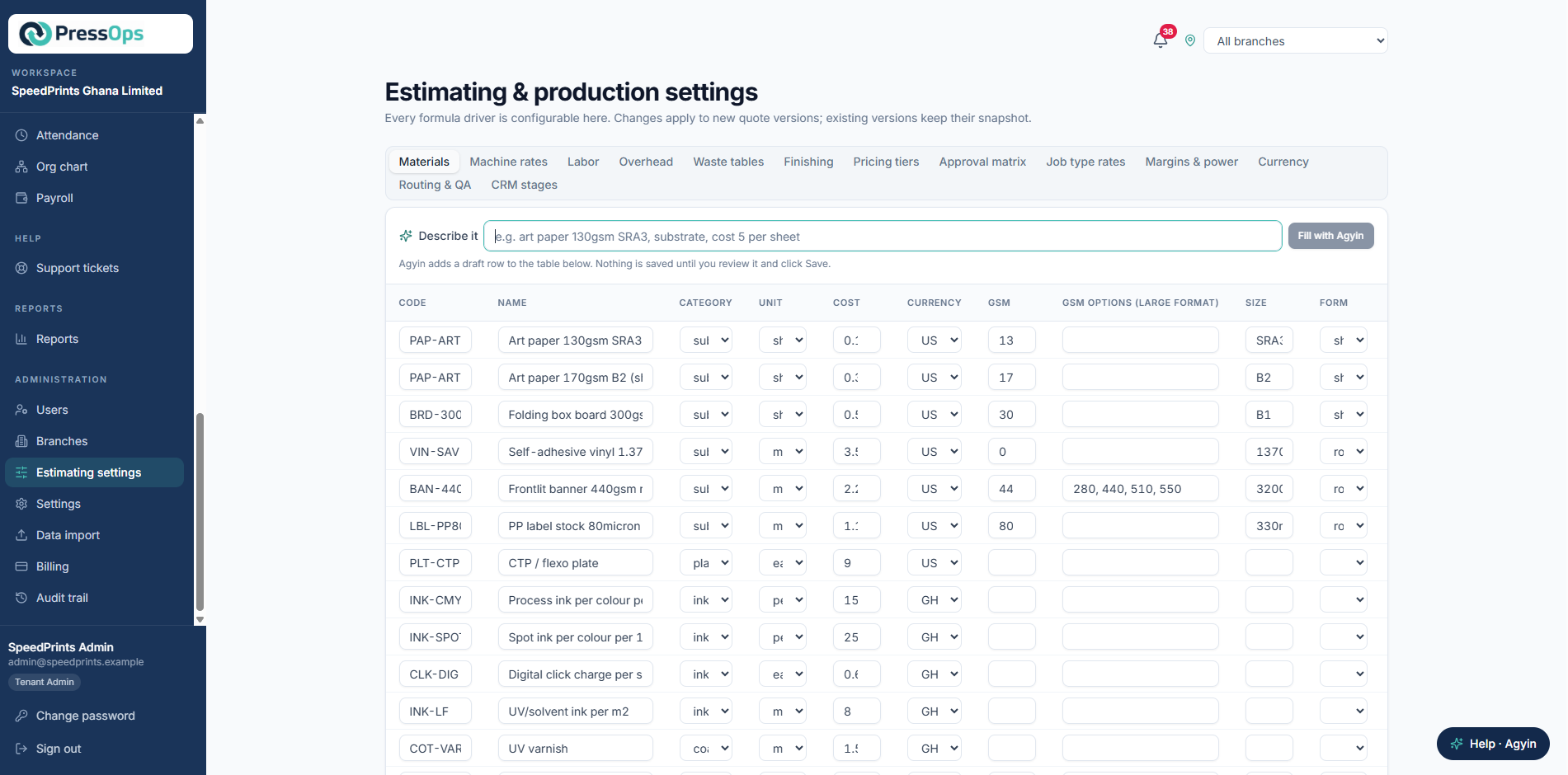
Configurable pricing brain
PressOps lets you configure the building blocks of your pricing.
- Materials and finishing libraries
- Machine rates and labour assumptions
- Overhead rules
- Volume tiers
- Rush surcharges
- Approval thresholds
This means your pricing knowledge becomes a system, not a person.
Approval chains and revision tracking
PressOps supports approval workflows and keeps a clear revision trail so changes do not slip through unnoticed.
A simple example: a 20,000 GHS job with waste factored in
Let's use a simplified example to show why waste and setup matter.
Assume you quote a job at 20,000 GHS.
If your estimate ignores waste and make-ready, you might under-allocate materials and time.
A basic way to protect margin is to include planned waste.
Example approach:
- Planned waste allowance: 5 percent of material cost
- Make-ready time: priced as setup time, not run time
- Finishing: priced as a separate line item with realistic time and consumables
If the job has a high-risk finishing step or tight deadline, you also apply a rush surcharge or require approval before sending the quote.
The point is not the exact percentage. The point is that your quote includes the costs you already know will happen.
What to look for in print estimating software
If you are shopping for printing quotation software, use these questions.
- Can it standardize materials, machine rates, and labour assumptions?
- Can it handle finishing and outsourced steps properly?
- Does it support approval thresholds and revision history?
- Can it generate volume tiers quickly?
- Can it apply rush surcharges consistently?
- Can it connect the quote to job costing later so you can learn and improve?
If the system cannot connect estimating to production reality, it will not protect your margins.
Next step: configure your pricing in PressOps
If you want to stop guessing and start quoting with confidence, the first step is to configure your pricing building blocks.
Book a demo of the PressOps Estimating module and see how your team can quote faster while protecting margin.
Internal links
References
- Sabre Limited: Print MIS vs ERP Systems: What's the Difference? sabrelimited.com